31 December 2011

New Year's Resolutions for Dog Owners


When I saw this assignment in my in-box, all I could think about were the years of broken resolutions.  Long ago I gave up giving things up – what is the point if you don’t stick with it anyway? Instead I started looking at the New Year as an opportunity for improvements. That method works much better for me. 2012 is a leap year and I would love to see us dog-people leap into improving our lives and those of our “fur family” members too. Here are some tips to get you started. 

Food - This year let’s try and feed our dogs the most nutritious diet we can. Does your food pass the dog food taste test? This doesn’t mean that your dog will eat it, but rather that you would eat it. If you wouldn’t eat the kibble, why would you expect your dog to eat it? If you aren’t sure about what your dog eats, you can learn how to read the labels. While you are at it, keep your dog at a healthy weight. Overweight dogs live shorter lives and can lead to conditions like diabetes. Keep your dog’s weight appropriate for his size. 

Exercise – I would love it if you were walking your dogs every day for about 45-minutes. It is great for them and for you too! Exercise helps them both physically and mentally and for those of you that have been in my classes you’ll recognize this statement: A tired dog is a good dog. Under the exercise umbrella I would add playing with your dog and really important, training your dog. 

Grooming – Brushing your dog and taking care of their basic maintenance is a great time for the two of you to bond. If you aren’t comfortable doing toenails, have a reputable groomer show you how or at the very least get your dog in to have toenails worked on.  In the Minneapolis area you can have a mobile groomer stop by to help with grooming tasks. 

Appreciate – sometimes we forget to make or take time to really appreciate our companions. Enjoy their personalities, their quirks, their successes. Build a strong relationship with your dog and help them live successfully in your home.

Please share your tips and resolutions in the comments. 

Happy New Year!

Email me anytime, tell me your story, and please subscribe to my columns! 


28 December 2011

2012 AKC Eukanuba National Championship Junior Showmanship


This coming year is so exciting for our new juniors! We have some new junior showmanship participants from Minnetonka and Lakeville that are excited about the possibility of heading to the National Championship show in Florida.

AKC has shared this information to help you get your junior handler ready for the event.
The December 2012 AKC/Eukanuba National Championship will be held in Orlando, Orange County, Florida on 15-16 December 2012.

Eligibility to enter the event is based on the Junior's accomplishments in both the show ring and in the classroom.

The requirements are:
  • Juniors must have 5 first place wins in an Open Class, with competition present. Wins must be earned between October 12, 2011 and October 10, 2012. Juniors must be under 18 years of age at the time of the wins. Age on the day of the show has no bearing.
  • Juniors must have a grade point average of at least 3.0 or equivalent for the 2011- 2012 school year. GPA must be verified by an official school transcript or home school information sent in and received by AKC prior to the entry form being sent to the Junior. Please submit official transcripts or home school information no later than October 23, 2012. Transcripts or home school information received AFTER October 23, 2012, WILL NOT BE ACCEPTED and no invitation/entry form will be sent. Transcripts may be sent as soon as the current semester ends. It is the Junior's responsibility to ensure that AKC has received all necessary documentation.
    Please send to: AKC, 8051 Arco Corporate Dr, Suite 100, Raleigh, NC 27617-3390 Attn: Juniors.
  • Dogs must conform to eligibility requirements as described in Conformation Junior Showmanship Regulations.
  • A signed parental permission form must be returned to the address listed above. 
All Juniors entered will compete in Preliminary classes, in which a specified number of Juniors will be selected by the judges to compete in Finals. Placements are not made in the preliminary classes.

The December 2012 judges for Junior Showmanship are Mrs. Jan Swayze-Curry and Mrs. Karen Mammano (Preliminaries) and Mr. William P. Shelton will judge the Best Junior Finals.
For questions regarding the AKC/Eukanuba National Championship, email Invitational@akc.org.
For questions regarding Junior Showmanship at the AKC/Eukanuba National Championship, email Juniors@akc.org.


Email me anytime, follow me on Twitter, tell me your story, and please subscribe to my Examiner - Dogs column!

26 December 2011

Buying a new puppy or dog -- what you need to know


Congratulations on deciding to add a dog into your life! Here are some tips to consider to assist you in finding the perfect companion.

AKC Registered and/or AKC Papers
The AKC (American Kennel Club) is a registry service, not a guarantee of quality. What registration papers tell you (in theory) is your new puppy or dog is the breed you are buying. That is all the papers mean. Registration papers are not a guarantee of quality or anything else. If the people you are buying your puppy from try and charge you extra for papers, RUN away from this deal. Charging extra for registration papers is against AKC rules. Report anyone trying this to the AKC. There are even some people that sell papers on a black market basis. You can contact AKC to check your papers.

How papers relate to the "real world." Papers are like the title to your vehicle. The title will tell you what type of vehicle you have, Ford, Dodge, Chevrolet. The title does not tell you it is a good special vehicle or that is worth more than any other vehicle. The title just tells you the vehicle you have is most likely the type that it says it is. Know what questions to ask your breeder about your new dog.


Color
Color is simply a genetic code. Is some breeds, diluted coat color can relate to other health issues like allergies and/or skin and coat problems. There are also breeds where color relates to more serious health problems. Study up on the breed you are interested in and know what issues can arise. Know what questions to ask your breeder about your new dog.

"Special" Ancestors
Do a little research into your breed. In any breed, many dogs can and do trace back to a common ancestor. Is the dog being touted a dog from recent breed history or are you looking at a name from 50+ years ago. Know what questions to ask your breeder about your new dog.

Price
If you look in the paper, you will see many dogs listed in the $100 dollar range. Remember the old saying, "You get what you pay for." These dogs are rarely a great deal.

Free to Good Home
This is frightening. Free dogs can end up anywhere. There are "harvesters" that travel around and pick up free puppies, kittens, dogs and cats. They can end up in research laboratories, as bait for dog fighting rings, or as breeders in a puppy mill.

Dogs as Gifts
Do not give a pet as a gift!

Championship Lines
There should be at least 4 dogs with titles in the first three generations. People that breed and show dogs will be proud to show you the photos, ribbons and trophies. A good breeder is breeding to improve the breed. Remember, just because the parents were "special" dogs doesn't mean all the pups will be special. Know what questions to ask your breeder about your new dog.

Show Quality
If you are searching for a puppy in the newspaper, you are most likely not purchasing a show quality pup. To a classified advertiser, the term show quality most likely means you are paying more money. For a puppy with the potential to be show quality, go to a breeder that is showing and breeding to help improve the breed. Know what questions to ask your breeder about your new dog.

Health Guarantee
As a general rule, this means the breeder will take back the unhealthy puppy and give you a replacement. Will the replacement be from the same litter? Is this a repeat breeding? Will the replacement puppy have the same health problems? Now that you have had your puppy for a period of time and bonded with him, do you really want to know what will happen once you return him to the breeder? Good breeders have good guarantees. Know what questions to ask your breeder about health and temperament.

Educate Yourself
Learn as much as you can about the breed you are interested in. Know what questions to ask your breeder about your new dog.

Finding Your Puppy or Dog
Find a reputable breeder. They won't be as "cheap" as a classified advertised puppy, but you will get more value for your money. Consider working with a breed rescue club and adopting an older dog.
Remember if you buy from a backyard breeder (someone who breeds without thinking or knowing why and/or how to improve the breed) or from a puppy mill (commercial breeding for the express purpose of making money) all you have done is padded someone's pocket and encouraged them to do it again.

If you are now asking yourself, "Where do I get a good puppy?" Start with the United Kennel Club and the American Kennel Club to learn more about breeds. You can also contact the national breed club to get more information and to locate a reputable breeder. In Minnesota, start with the Minnesota Purebred Dog Breeders Association 

 
Email me anytime, follow me on Twitter, tell me your story, and please subscribe to my Examiner - Dogs column!

23 December 2011

Senior pet care tips


It seems like only yesterday that your pup literally ran circles around you when you went for walks, with lots energy to spare. Now your dog has a hard time making it up the stairs, and the vision and hearing aren't as good as they once were either. Sometimes she gets confused, yet the veterinarian tells you there is nothing seriously wrong with her; she's just getting older. Dogs age, just as humans do -- only more quickly. If your pet seems to be slowing down, here are some things you can do to help.
  1. Watch your pet carefully, keeping track of where she is in the house. She may need assistance finding her way around.
     
  2. Watch with particular care as she climbs up or down the stairs, and help your pet if needed. If she is small and you are strong enough, you may need to carry her up and down the stairs.
     
  3. If you also have a younger dogs(s), walk the older animal separately from the youngsters so the older dog can go at a slower pace instead of struggling to keep up with the others.
     
  4. Make sure your dog is eating properly. A good super premium senior food is an excellent choice for the geriatric dog. Don't give her hard bones to chew on; she may not be able to handle them.
     
  5. Never let her roam loose outdoors. When she is outside the confines of your fenced yard she may easily become lost or become the target of a more aggressive animal.
If you need something for your aging dog, visit a local pet retailer like Pet Stuff  where you can learn what products make the most sense for your companion.


Email me anytime, follow me on Twitter, tell me your story, and please subscribe to my Examiner - Dogs column!

21 December 2011

Whistle training your dog


Game Fair was a full swing summer event by our old house and I heard lots of whistling for dogs, but not too many that would make sense to the dog hearing them . Here are some tips to help you teach your dog to respond to a whistle. 


Whistle training is really easy and doesn't take too much time. In it's simplest form, all you do is blow your whistle right before giving the verbal command that your dog all ready understands. I like the two-tone whistles for training because the end with the ball inside is louder and the sound will carry over longer distances.  The opposite end (without the ball) is great for close work and so loud that your dog will be blasted with sound and doesn't annoy other people in the general vicinity. The following tips should help you get your dog working quickly to the whistle. I would practice these commands alone so you get the hang of them before using them with your dog.

COME. Bring the tip of your tongue to the roof of your mouth just behind your front teeth, then blow into the whistle. Your tongue will flutter. (I think it sounds like quail flushing.) Now flutter your tongue as you blow into the whistle. It should make a trilling sound. A long trilling sound is best for your COME command. 


SIT. There is no whistle sound for HEEL, the dog should always be close enough to hear our voice for the HEEL command. After HEEL, blow one sharp authoritative blast immediately before telling your dog to SIT. If the dog doesn't sit immediately, assist him into the position, but do not blow the whistle again. Initially all the SIT work will be up close. By the time the dogs are ready to be away from us, the SIT command will be well established. One sharp authoritative blast will be the SIT signal.


RELEASE. This is the verbal command to allow the dog to leave a STAY command. Later this command will precede the FETCH command and may even take place of FETCH meaning it is okay to go after the dummy or bird. It is useful in the field when the dog should be quartering and they are lazy or hanging around their dog friends. Start with the SIT whistle, then give a new direction with your arm as you blow your whistle for GO. Begin by blowing two rapid notes into the whistle, tweet-tweet, immediately before saying GO at the target (food and treats work well for this exercise.) Two rapid notes, tweet-tweet will be the release signal.


Once your dog is reliably responding to the whistle, vary your commands. Sometimes just use the whistle, sometimes just voice, sometimes just hand signals. Keep practicing the various "languages" you have taught your dog so he will respond reliably to all of them. Don't stop training with the whistle once your dog has the concept. Like people, they can forget quickly. Keep using the whistle, your voice and hand signals so your dog has a great working knowledge of all commands in all languages. 


When your dog is handling well with the whistle, don't get a big head over it. Only use your whistle when you need to, otherwise you may start to nag your dog and annoy everyone around you. (Over use of the whistle also brands you as an amateur.) Learn to use your whistle only when necessary. 

Whistle SOS
If you ever get lost in the woods, use your whistle to help people locate you. The whistle will be more effective than the three shot SOS from your shotgun. Morse Code for SOS is: short-short-short, long-long-long, short-short-short. SOS on the whistle indefinitely. If it really gets bad, put the whistle in your mouth and your breath will make enough noise that a trained Search and Rescue dog may locate you. 


Email me anytime, follow me on Twitter, tell me your story, and please subscribe to my Examiner - Dogs column!


19 December 2011

Retriever play training


When starting puppies on retrieving, use something light and easy to carry like a small dummy or socks stuffed with rags. Don't throw sticks, play tug-of-war games or train two pups at once letting them compete for the dummy, these practices all promote chewing and hard mouths -- things we don't want to see in pups or adult dogs. 

Small dummies and socks are easy for pup to retrieve, you won't be able to throw them too far and they won't bounce like a tennis or rubber balls do. The socks have an advantage of having your scent on them and can be easier for pup to find. Before you start using your dummy, carry it around for a few days or wipe some perspiration on it to give more scent than just your hands will. Have faith, your scent is critical later on. 

The reason we are working with the dog is to avoid creating bad habits. There will be no "toss and hope." When your dog decides to run around you and see if you'll play the chase me game, there will be no yelling, no punishment or threat of punishment. To help you be successful, position yourself between the dog and the crate. Most likely, your dog will want to run to his "apartment" and play with the new prize. Catch him as he runs by. (A check cord can be helpful here.) 

THROW the dummy a few feet (always underhand and always past the pup's eyes) say FETCH as he runs toward the dummy to pick it up. Then if needed, urge (NEVER YANK) him back toward you with the check cord. PRAISE the dog a lot as you say GIVE and take the dummy. If pup doesn't release the dummy, you can push it farther back in the mouth. He'll shove it out with his tongue. 

If the pup isn't interested in the dummy, tie a cord to it and toss it again. If he runs toward it and then losses interest, give the dummy a yank. More than likely, he will pounce on it and then you can lure him back to you. 

Some dog's interest can be peaked by dropping a tennis ball. It bounces, he tries to catch it, but bumps it with a clumsy puppy foot. The ball rolls farther, urging the pup to chase. Finally he grabs the ball and amazingly, you are both having fun. 

For the play method to work, the sessions must remain fun. Don't make it work by overdoing. Practice a little play obedience and play fetch for a few minutes each, then quit. Enthusiastic pups can fetch six times, pups that get bored easily should only do two or three fetches. Remember puppy attention spans are very short. It is better to play train for five minutes several times a day than one marathon session. QUIT WHILE YOU ARE AHEAD , long before pup becomes bored. 

Don't let yourself become angry while training, that will make pup dread your sessions together. No matter what happens, maintain the excited spirit of play. If you are saying sweet things through gritted teeth, your dog will know you are angry. If you don't have patience, take acting lessons so your dog won't suffer. 

After your play session is over, take the pup back to the house or kennel. NO MORE PLAY OF ANY KIND. This play training is his play. He will look forward to play training and later to more serious training if he is never permitted aimless self-play outside the house or kennel. The dog's enthusiasm for your "play" will be enhanced so you will always have his attention. This will save an enormous amount of training time.


Email me anytime, follow me on Twitter, tell me your story, and please subscribe to my Examiner - Dogs column! 


15 December 2011

House training your dog


Going to the bathroom in the house is one of the biggest issues for new puppy owners. You can easily win the battle if you are consistent, patient, use supervision, utilize confinement and reward your pup with scrumptious treats. Remember, you are teaching your puppy where to relieve himself rather than where not to relieve him or herself. 
 
One of your first steps is to choose a place that you want your pup to eliminate. Once you have chosen the spot, always take your pup on leash to the spot and stand there for three to five minutes. If you don't have success, take pup back inside and place them in their crate. When you are home, make this trip every hour or two and praise success with voice and treats to expedite the learning process. You pup will quickly learn that elimination bring tasty rewards.

Use a Crate. Most dogs love their "den" as long as it is the right size. If it is too big, part of it will become a bathroom. If it is too small, it is uncomfortable. Your pup should have enough room to stand up, turn around and lay down. When pup is in the crate, provide a food stuffed chew toy like a Kong so pup has something to occupy the confinement time. The crate should help you predict when the pup needs to "go" so you can teach pup where and why it needs to eliminate outdoors.

Outside Time: Puppies need to relieve themselves frequently. Ideally, your pup should go outside every two hours.
Same Time, Same Place: Take pup out on a six-foot leash and stand in the place you want pup to "go." Praise pup for "going" in the right location.
Boo Boo? Show pup his mistake and let him know he was wrong with a firm "No!" Take pup outside and show him how you want it done. (Not literally!)
Don't rub pup's nose in "it" unless you want him to eat "it."
Don't smack him with a rolled up newspaper unless you want him to eat it. If you want to hit something with a newspaper, roll it up and hit yourself for not paying more attention to pup's needs.
Feed to Succeed: A high quality, nutritional, highly digestible diet keeps odors, waste and trips outside to a minimum.
Take pup out:
  • After eating
  • After napping
  • After a play session
  • First thing in the morning
  • Last thing at night
  • When his eyes are crossed
The biggest key to house training success is consistency. The more consistent you are with pup, the quicker pup will give you the desired response. When pup relieves himself outside, pup earns more free time inside your home. One quick method is alternating freedom and confinement. On a basic level the following guidelines will help you train your puppy:
  • Follow the house-training schedule strictly. If pup has an accident you have allowed too much freedom.
  • While standing in one spot with pup on a leash, allow two minutes for relieving himself. Reward immediately (within one second) with a treat or praise after the desired behavior. 
  • Holding "it" all night is the first stage to successful housebreaking.
If your puppy whines and cries at night, please try to ignore the commotion and go back to sleep. (This applies unless pup is hurting itself.) If you get up even to reprimand pup for making noise, you have just shown your pup that you will get up at night. Occasionally dogs must relieve themselves at night, and ignoring will lead to a big mess in the morning. You can respond to the pup's warning by allowing pup out for only two minutes, and keeping the entire event as low key as possible. For an easy routine to assist in quickly training your pup to "go outside" and avoid most accidents, follow this simple schedule:
  • In the morning, carry your pup outside and place it on the ground (attached to your leash) that you have designated as the bathroom. Give your command to "go to the bathroom" or "potty" or "tinkle" or some other suitable phrase. Allow two minutes for a response. Gently repeat the command (in a tone of voice like you use with your coworkers) and as soon as pup responds, reward immediately. Remember to bring your reward treat with you no matter how optimistic or pessimistic you feel.
  • If pup fails to respond within the allotted time, carefully take it inside and place it back in the crate until you are dressed and ready to try again. 
  • When your pup responds correctly, give lots of praise and of course your scrumptious treat. Giving the treat reinforces the desired behavior.
  • Now pup is going to the bathroom outside and can earn some freedom in your home. The following table shows a suggested daytime schedule.
Goes to the bathroom outside
1/2 hour free time
1-1/2 hours of confinement
This routine continues until pup learns to "go" on command and earns your trust. At that time you can allow more freedom then go to the next level.
Goes to the bathroom outside
1 hour free time
2 hours confinement
This routine continues until pup is doing well. At that time you can allow more freedom.
Goes to the bathroom outside
2 hours free time
2 hours confinement
This entire process may take up to six weeks. Follow the basics covered here and DON'T become discouraged. They are only pups once and we should enjoy all aspects of new companion's lives.
 
 
Email me anytime, follow me on Twitter, tell me your story, and please subscribe to my Examiner - Dogs column!
 

13 December 2011

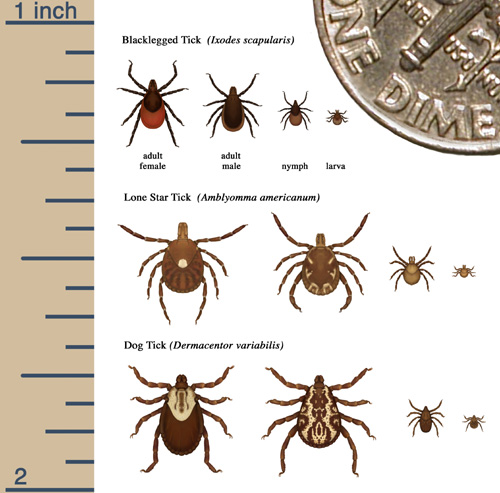
Keep ticks off your pets


Ticks

  • Check your pet's skin every 24-48 hours and after being in tick infested areas. Ticks need to be attached for 48 hours to spread disease.
  • Remove brush and clear dead leaves from around your house and kennel areas.
  • Use tick prevention like collars, shampoos, powders. (Be sure the prevention is not worse than the disease.)

Tick Transmitted Diseases

  • Lyme disease. Caused by the Borrelia burgdorferi bacteria, which is carried by the tiny deer tick. Symptoms usually take 2-5 months to appear after exposure and include fever, lameness and lethargy. Lyme disease responds well to antibiotics, but damage to the joints can be permanent. A vaccine is available, but does not ensure total protection.
  • Rocky Mountain Spotted Fever. Transmitted by the American Dog Tick. Often accompanied by neurological signs like dizziness and seizures as well as muscle and joint pain.
  • Diseases carried by ticks include those caused by the Haemobartonella microorganism, the Babesia parasite and Ehrlichia. Symptoms of these blood borne diseases include anemia and weight loss.

TICK REMOVAL

  • Use a fine tipped tweezers or tick removal tool.
  • Grab the tick by the mouth or head and pull directly outward. Do this quickly so you don't crush or irritate the tick into releasing harmful bacteria into your pet's blood stream. Toss it into a jar of alcohol to kill it.
  • Clean the bite wound with a pet safe disinfectant and apply a small amount of triple antibiotic.
  • A small reaction like a bump may occur.
  • Wash your hands thoroughly after removing a tick.

Tick Links