Showing posts with label tick diseases. Show all posts

14 December 2012

Ticks


Because of the extra-mild winter this year, the early spring could bring an unwelcome guest: the tick. Be warned: The warmer weather is good news for people and pets who want to be outside, but beware of an uptick of the hard-to-detect pest. 

The basic reason is that the eggs will hatch sooner. "Eggs are already in the ground, but this is the time that they will be coming out in great numbers," said Pollie Rueda, an entomologist stationed at the Smithsonian and Walter Reed Army institute of Research. He noted that the normal tick season is from May through August, but with the 70-degree temperatures in some places, the ticks may get a jump on the season.
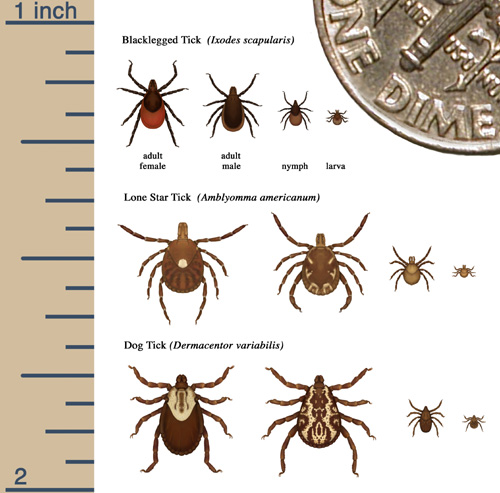
Ticks that are already out and about are the visible adult, sesame-sized ones, noted Kristen Nordlund of the Centers for Disease Control and Prevention. 

Think of these little buggers as the arachnid form of vampires. They hang out in blades of grass for a host to come along -- a mouse, a dog, or a human -- to attach themselves and feed off your blood over days, or until discovered, and they often leave disease behind -- sometimes multiple illnesses. 

The big concern for humans, according to the CDC, is that most tick infections occur during the "nymph" stage. Those recently hatched ticks are the size of the period at the end of this sentence, and they have four sets of legs and the ability to suck your blood. Because they are essentially invisible, preying on a host can easily go undetected. 

In most cases, the tick must be attached for 36-48 hours or more before the Lyme disease bacterium can be transmitted. Infections from ticks, such as Lyme disease (plus babesiosis, Rocky Mountain spotted fever, and anaplasmosisis), are on the rise and are difficult to diagnose. The symptoms are awful: from headaches to long-term joint pain and even heart problems. 

Since 1992, the cases of Lyme disease have doubled, according to the CDC, and more than 21,000 cases are reported every year. 

The CDC is conducting tests on actual households to confirm if spraying a pesticide in the backyard helps to reduce the incidence of human disease. Check its website for good information on preventive measures. 

Thanks for stopping past! Let me know if there is something you would like to know more about.

13 December 2011

Keep ticks off your pets


Ticks

  • Check your pet's skin every 24-48 hours and after being in tick infested areas. Ticks need to be attached for 48 hours to spread disease.
  • Remove brush and clear dead leaves from around your house and kennel areas.
  • Use tick prevention like collars, shampoos, powders. (Be sure the prevention is not worse than the disease.)

Tick Transmitted Diseases

  • Lyme disease. Caused by the Borrelia burgdorferi bacteria, which is carried by the tiny deer tick. Symptoms usually take 2-5 months to appear after exposure and include fever, lameness and lethargy. Lyme disease responds well to antibiotics, but damage to the joints can be permanent. A vaccine is available, but does not ensure total protection.
  • Rocky Mountain Spotted Fever. Transmitted by the American Dog Tick. Often accompanied by neurological signs like dizziness and seizures as well as muscle and joint pain.
  • Diseases carried by ticks include those caused by the Haemobartonella microorganism, the Babesia parasite and Ehrlichia. Symptoms of these blood borne diseases include anemia and weight loss.

TICK REMOVAL

  • Use a fine tipped tweezers or tick removal tool.
  • Grab the tick by the mouth or head and pull directly outward. Do this quickly so you don't crush or irritate the tick into releasing harmful bacteria into your pet's blood stream. Toss it into a jar of alcohol to kill it.
  • Clean the bite wound with a pet safe disinfectant and apply a small amount of triple antibiotic.
  • A small reaction like a bump may occur.
  • Wash your hands thoroughly after removing a tick.

Tick Links

20 October 2008

Ticks


Keep ticks off your pets


  • Check your pet's skin every 24-48 hours and after being in tick infested areas. Ticks need to be attached for 48 hours to spread disease.

  • Remove brush and clear dead leaves from around your house and kennel areas.

  • Use tick prevention like collars, shampoos, powders. (Be sure the prevention is not worse than the disease.)

Tick Transmitted Diseases


  • Lyme disease. Caused by the Borrelia burgdorferi bacteria, which is carried by the tiny deer tick. Symptoms usually take 2-5 months to appear after exposure and include fever, lameness and lethargy. Lyme disease responds well to antibiotics, but damage to the joints can be permanent. A vaccine is available, but does not ensure total protection.

  • Rocky Mountain Spotted Fever. Transmitted by the American Dog Tick. Often accompanied by neurological signs like dizziness and seizures as well as muscle and joint pain.

  • Diseases carried by ticks include those caused by the Haemobartonella microorganism, the Babesia parasite and Ehrlichia. Symptoms of these blood borne diseases include anemia and weight loss.


TICK REMOVAL


  • Use a fine tipped tweezers or tick removal tool.

  • Grab the tick by the mouth or head and pull directly outward. Do this quickly so you don't crush or irritate the tick into releasing harmful bacteria into your pet's blood stream. Toss it into a jar of alcohol to kill it.

  • Clean the bite wound with a pet safe disinfectant and apply a small amount of triple antibiotic.

  • A small reaction like a bump may occur.

  • Wash your hands thoroughly after removing a tick.


Tick Links (These links will take you away from the blog)
CVM-Oklahoma State - Tick Explanations and Pictures
AVMA - Tick and other Parasite Information
Pet Education - Tick Life Cycles, Anatomy and Disease Transmission